News•2025-10-19
The King presides over a Council of Ministers and appoints Tarik Senhaji as head of the AMMC
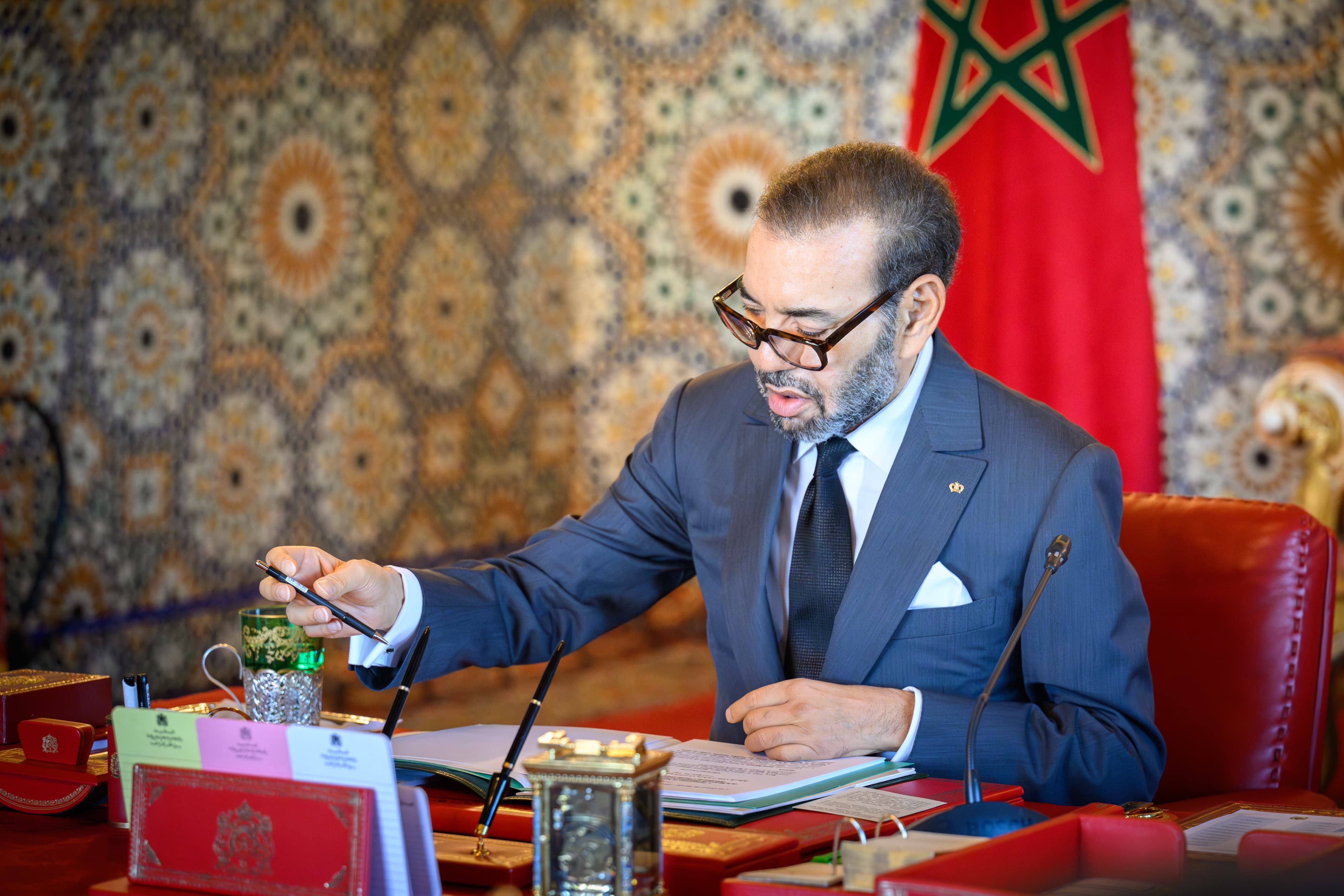
His Majesty King Mohammed VI, may God assist him, presided over a Council of Ministers on Sunday, October 19, 2025, at the Royal Palace in Rabat, as stated in a communiqué from the Royal Cabinet.
The meeting was dedicated to reviewing the general guidelines of the Finance Bill for the year 2026, approving organic law projects, two military-related decrees, and a series of international agreements and high-level appointments. In accordance with Article 49 of the Constitution, the Minister of Economy and Finance presented an overview of the main lines of the 2026 Finance Bill to His Majesty the King.
The Minister emphasized that this project was developed in light of the High Royal Guidelines and Instructions, particularly from the last two speeches during the Throne Day celebration and the opening of the legislative year. It comes amid an international context marked by uncertainties that are affecting global growth prospects. Nationally, the economy is expected to grow by 4.8% this year, supported by a recovery in domestic demand and the vitality of the productive sector, particularly in non-agricultural activities.
These encouraging economic performances have been bolstered by controlled inflation at 1.1% as of the end of August 2025, and a continuous reduction in the budget deficit, projected to be 3.5% of GDP. The Finance Bill also aims to accelerate the "Emerging Morocco" projects and achieve national development that combines social justice with integrated territorial development, benefiting the entire population equally.
To this end, the 2026 Finance Bill focuses on four major priorities: First, consolidating economic gains to strengthen Morocco's position among emerging nations by stimulating private investments, both domestic and foreign, and accelerating the efficient implementation of the Investment Charter. It also aims to enhance the attractiveness of the business climate and strengthen innovative Public-Private Partnerships while diversifying sources of financing for the economy.
Special attention will be given to micro, small, and medium enterprises, which are significant sources of employment in the national productive fabric. This will include establishing a new technical assistance framework and financial support to encourage their investments for job creation and territorial equity. Efforts will also be intensified to integrate youth and women into the workforce and mitigate the impact of drought on rural employment, alongside continuing support programs for livestock farmers to rebuild the national herd.
Second, the launch of a new generation of integrated territorial development programs will focus on local specificities, strengthening advanced regionalization, and the principle of solidarity among territorial entities. These programs will be designed based on broad consultations with various local stakeholders, prioritizing job creation for youth and the concrete promotion of education and health sectors, as well as territorial upgrading.
Particular attention will be given to regions in extreme poverty, including mountainous areas and oases, sustainable coastal development, and the expansion of the National Program for the development of emerging rural centers. Additionally, in line with High Royal Instructions, the 2026 budget will emphasize increasing financial efforts for health and national education sectors, aiming for a total allocation of 140 billion dirhams, along with the creation of over 27,000 budgetary positions in these sectors.
In the health sector, the focus will be on improving healthcare infrastructure, including the commissioning of two University Hospital Centers in Agadir and Laâyoune, completing the construction and equipping of Ibn Sina University Hospital in Rabat, and continuing work on the University Hospitals in Béni-Mellal, Guelmim, and Errachidia, as well as launching an upgrade and renovation operation for 90 hospitals.
Simultaneously, efforts will accelerate the implementation of educational reform, including the expansion of preschool education, enhancing support services for schooling, and improving the quality of education.
Third, the consolidation of the pillars of the social state will continue through the ongoing implementation of the Royal project for the generalization of social protection and the operationalization of the social aid program benefiting 4 million households. This will include increasing monthly child aid amounts between 50 and 100 dirhams per child for the first three children, accompanied by special aid for orphans and abandoned children in social protection institutions.
This also involves operationalizing the remaining pillars of this project, particularly expanding affiliation to pension schemes and generalizing unemployment benefits, alongside continuing the direct aid program for acquiring primary housing.
Fourth, the continuation of major structural reforms and the preservation of public finance balances will be pursued, notably through reforming the Organic Law related to the Finance Law, reflecting a profound change in the governance of public policies, oriented towards accountability, achieving results, and ensuring cross-cutting and territoriality in managing these policies.
The restructuring of public establishments and enterprises will also be accelerated to improve their performance and investment effectiveness, with a focus on balanced territorial distribution. Furthermore, the reform and modernization of the judicial system will continue to bring justice closer to citizens and enhance the attractiveness of the business climate.
Following the approval of the general guidelines of the 2026 Finance Bill by the Council of Ministers, four organic law projects were adopted. These include two organic laws related to the House of Representatives and political parties. The organic law concerning the House of Representatives aims to ensure the integrity of upcoming legislative elections and to guarantee their legitimacy by prohibiting entry to the parliamentary institution for anyone who has been subject to a verdict resulting in loss of eligibility.
It also proposes measures to deter electoral fraud and encourages youth under 35 to engage in politics by simplifying candidacy conditions and providing significant financial incentives to cover 75% of their campaign expenses. Additionally, it reserves electoral constituencies exclusively for women to support their representation in parliament.
The organic law concerning political parties primarily aims to modernize the legal framework governing them, establish rules to enhance the participation of women and youth in party formation, improve governance, and regulate their financing and accounting to adapt to the profound changes in Moroccan society.
The other two organic law projects concern defining the conditions and procedures for raising a constitutional exception against a law, and amending the organic law related to the Constitutional Court. The first project aligns with Article 133 of the Constitution, which grants the Constitutional Court the authority to rule on constitutional exceptions raised by parties in disputes regarding laws that infringe on rights and freedoms guaranteed by the Constitution.
This project considers the Constitutional Court's decisions regarding certain judgments deemed unconstitutional. The project related to the Constitutional Court aims to enhance its effectiveness and operational rules, particularly by limiting the right to appeal against the election processes and results of members elected by both Houses of Parliament.
It also relieves the Constitutional Court from notifying interested parties of its decisions on appeals related to the elections of members of both Houses of Parliament, assigning this responsibility to the authority in charge of receiving candidacy declarations for these elections. Furthermore, the project prohibits a member appointed or elected to replace a member whose term has ended prematurely from being reappointed or re-elected if the replacement period exceeds three years.
The Council of Ministers subsequently adopted two decrees concerning the military sector. The first decree establishes a special status for officials of the General Directorate of Information Systems Security at the Ministry of National Defense, aimed at attracting the required competencies through flexible and efficient recruitment processes and the establishment of a comprehensive incentive allowance, in line with the technicality and sensitivity of their missions.
The second decree modifies and complements provisions related to the organization and management of the Royal School of Military Health Service to align them with legislative and organizational texts related to the reform of the national health system and to allow admitted candidates to benefit from the financial status granted to officer students of various military schools, alongside the creation of a "Scientific Research Council" tasked with setting research priorities and undertaking related activities.
In the context of strengthening partnership and cooperation relations between Morocco and several brotherly and friendly countries, and consolidating its position on continental and international levels, the Council of Ministers approved 14 international agreements, including ten bilateral and four multilateral agreements.
The bilateral agreements cover judicial and military cooperation, social security, air services, mutual recognition of driving licenses, and the elimination of double taxation. The multilateral agreements involve seat agreements under which Morocco will host the headquarters of the African Organization of Supreme Audit Institutions, Economic and Social Councils, and similar institutions in Africa, as well as the London Protocol on the maritime transport of passengers and their luggage and the Geneva Convention on updating the identity documents of seafarers.
Under Article 49 of the Constitution and upon the proposal of the Head of Government, and at the initiative of the Minister of Interior, His Majesty the King appointed several Walis and Governors in the Territorial Administration:
1. Mr. Khatib El Hebil, Wali of the Marrakech-Safi region, Governor of the Marrakech Prefecture.
2. Mr. Khalid Ait Taleb, Wali of the Fès-Meknès region, Governor of the Fès Prefecture.
3. Mr. Mhamed Atfaoui, Wali of the Oriental region, Governor of the Oujda Angad Prefecture.
4. Mr. Fouad Hajji, Governor of the Al Hoceima Province.
5. Mr. Hassan Zitouni, Governor of the Azilal Province.
6. Mr. Sidi Saleh Daha, Governor of the El Jadida Province.
7. Mr. Abdelkhalek Marzouki, Governor of the Casablanca-Anfa Prefecture.
8. Mr. Mohamed Alami Ouaddan, Governor of the Zagora Province.
9. Mr. Mustapha El Maaza, Governor of the Al Haouz Province.
10. Mr. Rachid Benchikhi, Governor of the Taza Province.
11. Mr. Mohamed Zhar, Governor of the Inezgane-Aït Melloul Prefecture.
12. Mr. Mohamed Khalfaoui, Governor of the Fahs-Anjra Province.
13. Mr. Zakaria Hachlaf, Governor of the Chefchaouen Province.
14. Mr. Abdelaziz Zerouali, Governor of the Sidi Kacem Province.
15. Mr. Abdelkrim Ghannami, Governor of the Taounate Province.
Additionally, upon the proposal of the Head of Government and at the initiative of the Minister of Economy and Finance, His Majesty the King appointed Mr. Tarik Senhaji as President of the Moroccan Capital Market Authority (AMMC).